

Make every person count: Why recording unassisted persons matters
19.10.26
When someone seeks help from a homelessness service but their request cannot be met, that experience matters.
The Unassisted Persons Collection is how the Specialist Homelessness Services Collection (SHSC) captures this unmet demand. It records people who seek assistance from a Specialist Homelessness Service but do not receive any service.
Yet, incomplete records can mean an incomplete picture in the data. In Victoria, almost 16,000 Unassisted Person records were missing information in 2024–25, despite more than 17,000 unassisted requests being recorded.
Records with missing information are not counted towards the total count of unassisted requests in the Australian Institute of Health and Welfare reporting.

What is an Unassisted Person?
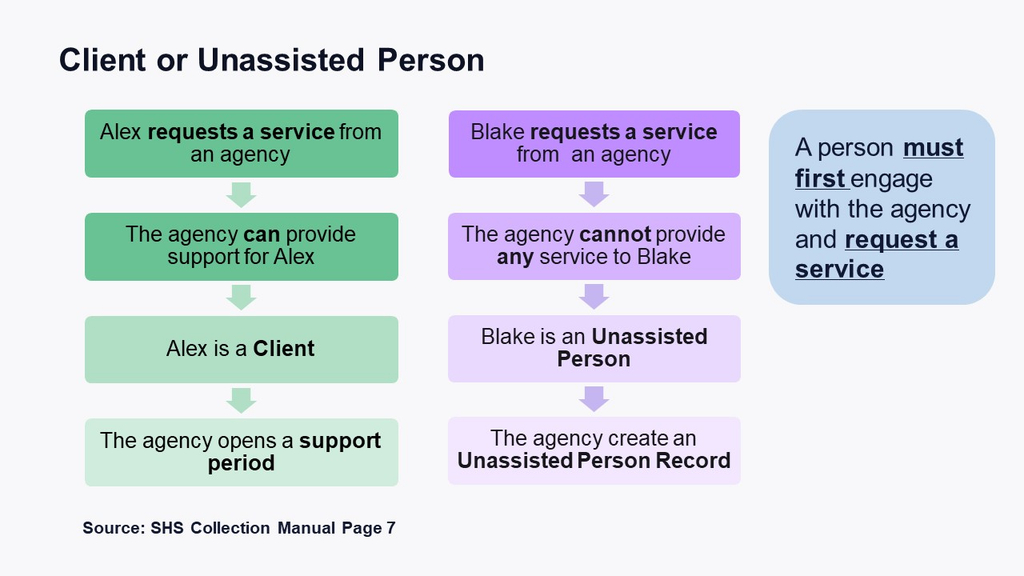
An Unassisted Person is someone who seeks a service from a Specialist Homelessness Service agency and does not receive any service.
It’s not about who showed up. It is about who asked for support and got nothing.
A person must first engage with an agency and request a service. If the agency cannot provide any service, an Unassisted Person record should be created.
A person should not be recorded as unassisted if they receive at least one direct service from the agency, or if the agency is planning to or is in the process of providing case management.
Remember – three fields help make every person count
Recording an Unassisted Person does not require extensive information.
There are three fields that must be completed:
- Year of birth: an estimate can be used (like 1970 or 1980).
- Sex: male, female or other.
- Reason: the service was not provided (select from the available list).
A person’s name can be left blank.
The reason a service was not provided is also important. The SHSC includes reasons such as no accommodation being available, insufficient staff, no other services being available, the agency being outside the appropriate area or target group, or the person not meeting service criteria.
New resources to support consistent recording
Council to Homeless Persons has developed, with input from the sector, practical resources to help workers record Unassisted Persons confidently and consistently, particularly workers involved in Initial Assessment and Planning and intake.
The resource pack includes:
- a short video explaining when to create an Unassisted Person record, why the data matters and the essential information to collect
- an information pack that teams can use to work through the key concepts
- a poster that services can display as a quick reminder.
The resources were developed in collaboration with members of the Specialist Homelessness Services Collection Community of Practice, drawing on sector knowledge and practical experience.
Stronger data strengthens our advocacy
Recording an unassisted request might seem like a small administrative action, but collectively these records help show where people are seeking help that services cannot provide.
More consistent recording strengthens both local understanding of unmet demand and the broader picture of pressure across Victoria’s homelessness service system.
Every Unassisted Person record is part of that picture.