
We know how to end homelessness. So what will it take for our governments to do it?
19.02.26
There’s an assumption that homelessness is simply an unavoidable part of life. An intractable problem that the most we can do is manage. It’s time we challenged that assumption head-on, because the evidence doesn’t support it.
Ending homelessness is not a utopian fantasy. It is not a Scandinavian experiment. It is not a promising pilot program from a city overseas. It is something Victoria has already demonstrated is within reach. So why aren’t governments jumping on the solutions?
Victoria’s From Homelessness to a Home (H2H) program proved we can support thousands of people sleeping rough into stable, lasting housing. An independent Australian Housing and Urban Research Institute evaluation found the program had a 95 per cent success rate of clients achieving long-term housing – until it was ended by the Government in 2024. Rental protection programs support people at risk of homelessness to retain their tenancies in 94 per cent of cases. And Infrastructure Victoria has examined the evidence and recommended the government build 60,000 additional social homes by 2040.
These aren’t theories anymore. Victoria has tested them, refined them, and watched them work. What we haven’t done is put them all together and backed them with the resources the scale of this crisis demands.
That gap between what we know works and what governments have chosen to fund is where the rubber hits the road. More than one in three people seeking homelessness assistance across the entire country last year were in Victoria. The state government’s Big Housing Build committed to 12,000 new social homes – a welcome start, but less than a fifth of what’s needed for the more than 67,000 Victorians on the social housing waiting list. And as the Productivity Commission’s most recent report damningly revealed, the proportion of public housing in the state’s social housing mix has dwindled, with a net increase of only 36 public homes in the past 9 years.
In the meantime, the state spent just $383.73 per person on social housing and homelessness services last year – a figure well below the national average, and dwarfed by what we spend on police and justice. For a crisis that is killing Victorians at an average age of 44, that is not enough.
And at a federal level, the Australian Government spends more on tax breaks for landlords than it spends on social housing, homelessness and rent assistance combined.
These are all government choices. Choices to leave people in homelessness. But choices can be changed.
Here’s what often gets lost in this debate: ending homelessness makes hard economic sense. Every person without stable housing cycles repeatedly through emergency departments, mental health services, and the justice system. The cost of inaction is not zero – it is enormous, and it falls on almost every part of the public budget. Investing seriously in housing is not spending money we don’t have; it is stopping the haemorrhage of money we are already spending badly.
But beyond the economics is a more fundamental question about who we are. Victoria is a state that leads the nation on the things that matter. From Treaty to voluntary assisted dying, from supervised injecting rooms to pill testing. We are proudly progressive. Ending homelessness belongs on that list. It is a chance to convert the values Victorians hold about themselves into a lasting legacy: a Victoria where hundreds of thousands of people are no longer without a home every night.
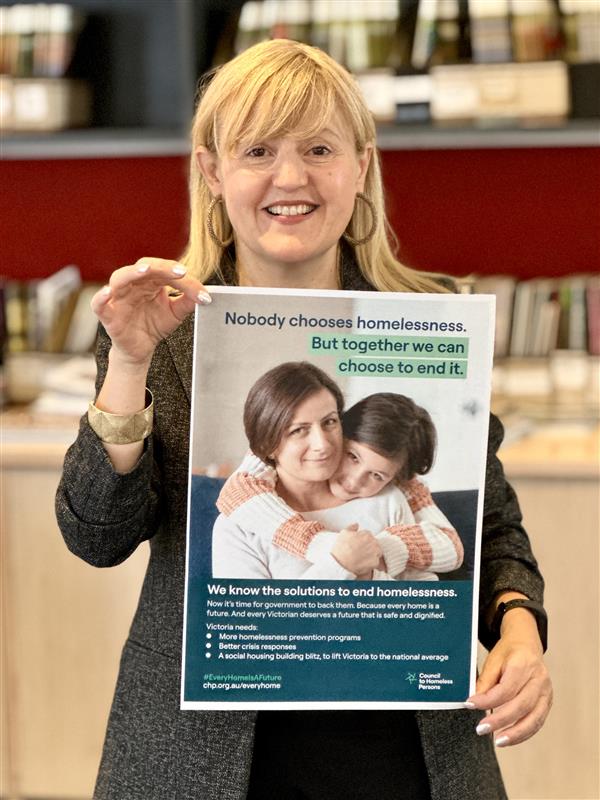
This World Day of Social Justice, it’s time we ended the assumption that homelessness is an issue doomed to never be solved. We must raise our voices as a community and make our leaders understand in the plainest terms: we have the evidence-based solutions at our fingertips. It’s essential they now show courage and compassion to back them, and end homelessness.
Deborah Di Natale
CEO, Council to Homeless Persons