

2025 was a historic edition of the Victorian Homelessness Conference, travelling for the first time to regional Victoria. Lived experience experts, homelessness workers and representatives from government and intersecting community organisations gathered in Ballarat on 27–28 November, for two days of discussion, sharing and planning.
The theme of the conference this year: Building Together and For Each Other.
What emerged was both a challenge and an invitation: to move beyond silos, beyond programs, and beyond our preconceptions, to instead build responses grounded in partnership, human rights, shared understanding and shared responsibility.


After a powerful Welcome to Country from Wadawurrung elder Auntie Kellie Phillips, which brought home the personal toll of family violence, the Conference’s opening plenary panel discussed the economic and infrastructure case for a large scale social housing build in Victoria.

Infrastructure Victoria Deputy CEO Jill Riseley outlined the process behind the state’s independent infrastructure advisor recommendation the State Government build 60,000 additional social homes by 2040. Economist Dr David Hayward told us that by scaling up public housing, Victoria can create a social housing system that is self-sustaining. And Ryan Smith, Head of Government Relations, Research and Advocacy at St Vincent de Paul Society and former Victorian Minister for Youth Affairs, recommended that in making our case to government for increased housing and homelessness support, we should always balance moral arguments for the Minister with an economic case for Treasury.
Moving into breakout sessions, attendees were treated to a wide range of panels and workshops ranging across streams including “Partnerships and Collaborations”, “Regional Responses”, “Lived Experience”, “System Reform”, “Better Practice” and “Diverse and Disproportionately Affected Communities”.


MCM’s Family Reconciliation Mediation Program team led an exploration of how alternative therapies (including nature, equine, body-based and many more forms of therapy) can improve engagement for trauma-affected young people. Therapists discussed how engagement and safety must come before intervention, and the power of non-clinical settings to reduce barriers and build trust.
This year’s Jenny Smith Housing First Scholar Zach Biggin joined with Wathaurong’s Karen Anderson and Ngwala Willumbong’s Liza Vanspall and CHP’s Alison Fraser to compare Housing First responses in Canada and on Country in Victoria. Zach shared that in Canada participants sometimes found that the private rental market gave them more choice and control than the social housing system. It meant they could live in the community and not be marked. Rather than head leasing, consumers were on the lease and received a subsidy through the program. Zach noted that this works because services are holding firm to Housing First principles. Karen and Liza both confirmed that social housing is the system preferred by their organisations. Liza shared that racism in the rental market is significant, and it also requires very high tenancy literacy, which can be a big ask for their vulnerable community.
Liza also spoke to the benefits that could come if more programs were self-determined responses, and the difficulty of retrofitting programs to collaborate with ACCOs. This echoed the challenge identified in the session “Partnering with ACCOs to deliver better outcomes: Learnings from Sacred heart’s J2SI program”. Despite these challenges though, this latter session identified many benefits that have come from the collaboration. Sacred Heart’s Garry Bourke spoke of how incorporating a self determination lens has made Sacred Heart Mission change standard practice, rebalancing the negotiables and non-negotiables. Bendigo & District Aboriginal Corporation’s Bobby Meloury said the partnership had also changed how they work, with learning about the partners’ shared and different experiences helping break out of entrenched ways of delivering housing and homelessness responses.


The panel “Older People’s Housing Conditions and Precarity” shone a spotlight on the concerning issue of increasing rates of homelessness amongst older people. Housing for the Aged Action Group shared new research conducted with Swinburne University , which has found 31% of participants living in private rentals reported that their homes were both unaffordable and in poor condition.
Homelessness experienced by people with insecure immigration status is an underdiscussed issue, and Meli’s “Supporting people at the intersection of homelessness, family violence and immigration” provided an insightful survey of the challenges experienced by this cohort, as well as a case study showing how effective response can provide them with stable housing. Panellists observed that intersecting systems can compound harm if responses are fragmented, and that coordinated, multi-agency responses outperform sequential referrals. Trauma-informed, culturally responsive, client-centred practice is essential. Safety and housing must be integrated with legal and migration support. And policy and funding must enable holistic, intersectional practice.

That notion in holistic, integrated intersectional responses was a recurring theme of the Conference.
We heard exciting examples of collaborations to integrate health and homelessness responses in Ballarat and in Queensland, with panellists again and again emphasising the importance of shared language and role clarity.

The panel “Redefining local government’s role in ending homelessness” stressed that while councils a key place-based leaders rather than service providers, able to play a strong role in convening, planning, advocacy and prevention around homelessness, cross-sector collaboration and shared language are critical – and effective responses rely on alignment with SHS and Stage Government systems.
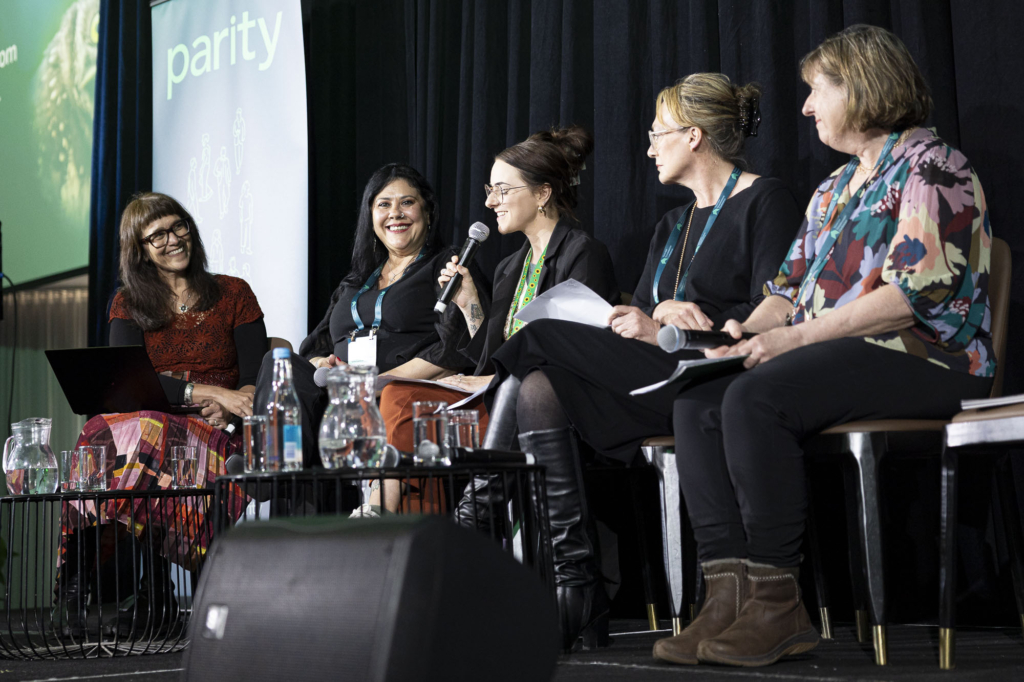
And the partnership discussion took centre stage in the Day 2 plenary “Beyond silos: Building transformative partnerships to end homelessness”. Here we heard that partnerships are not optional – they are essential infrastructure. Transformative change requires values-led, cross-sector collaboration. Local governments convening, philanthropic organisations enabling, and services holding relationships. To be effective, these partnerships need trust, clarity of roles, and genuine power-sharing. Critically, participants stressed that collaboration must be resourced and sustained.

Leaving Ballarat on Friday afternoon, three key messages particularly resounded. First, how often we heard that policy and practice is always improved by embedding lived experience, and providing co-ordinated, integrated responses. Second, the advice of David Pearson, CEO of the Australian Alliance to End Homelessness, that true transformative collaboration is about finding ways to work with people outside our existing circles and comfort zones. And most powerfully, the reminder of lived experience advocate during her welcome to Day Two: we cannot whisper our way to reform.
We hope you all left the Conference inspired to be loud, be innovative and be collaborative as we continue the vital work of ending homelessness in Victoria.
Our thanks to the Victorian Homelessness Conference’s Platinum Sponsor Homes Victoria, its Gold Sponsors the Salvation Army and MCM, and to all the other sponsors and exhibitors who helped make this important event possible.
All Conference registrants can now watch every main room session on demand the Conference portal. Recordings will remain available to watch until the end of February 2026.
Click here for our recap of the 2025 Victorian Homelessness Achievement Awards!