

On the road with assertive outreach
22.04.26
By Kim Thomson, Parity editor, Council to Homeless Persons

For assertive outreach workers, connecting with people in a consistent, compassionate way often feels like the “best job in the world” – but under-resourcing can restrict their options to provide support.
–
“Have we checked the gas bottle?”
Ada and Luke are making sure their van is packed with all the supplies they need for the day – food, bottled water, toiletries, camping gear and, today, a barbeque.
The pair are assertive outreach workers in Uniting Vic.Tas’s Street 2 Home team, based in Ballarat. They’re getting prepped for an outreach trip, visiting rough sleepers in a nearby campground.
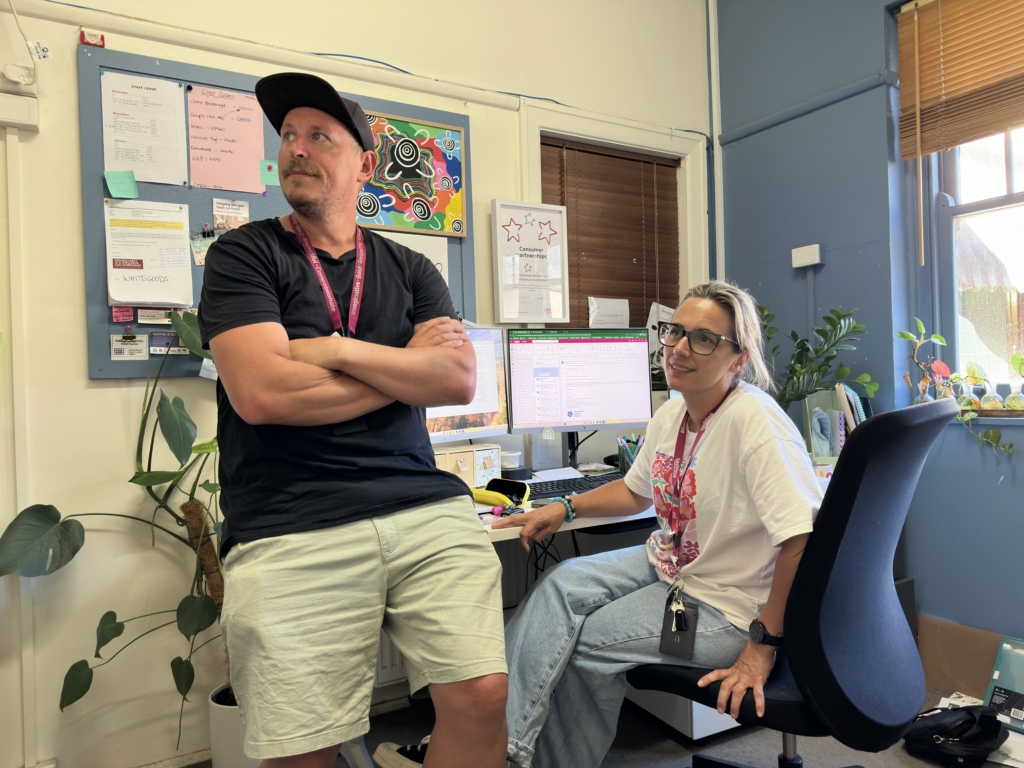
Before heading off, Ada points to a list of names on a whiteboard on her office wall. Some people are listed by first names and others just by monikers – “scrap metal”, “blue car”, “uber delivery”.
They’re the people the team has connected with recently, in the several regular locations they visit just outside of Ballarat. Some offer their names when the workers come to chat with them, others are more reluctant to share.
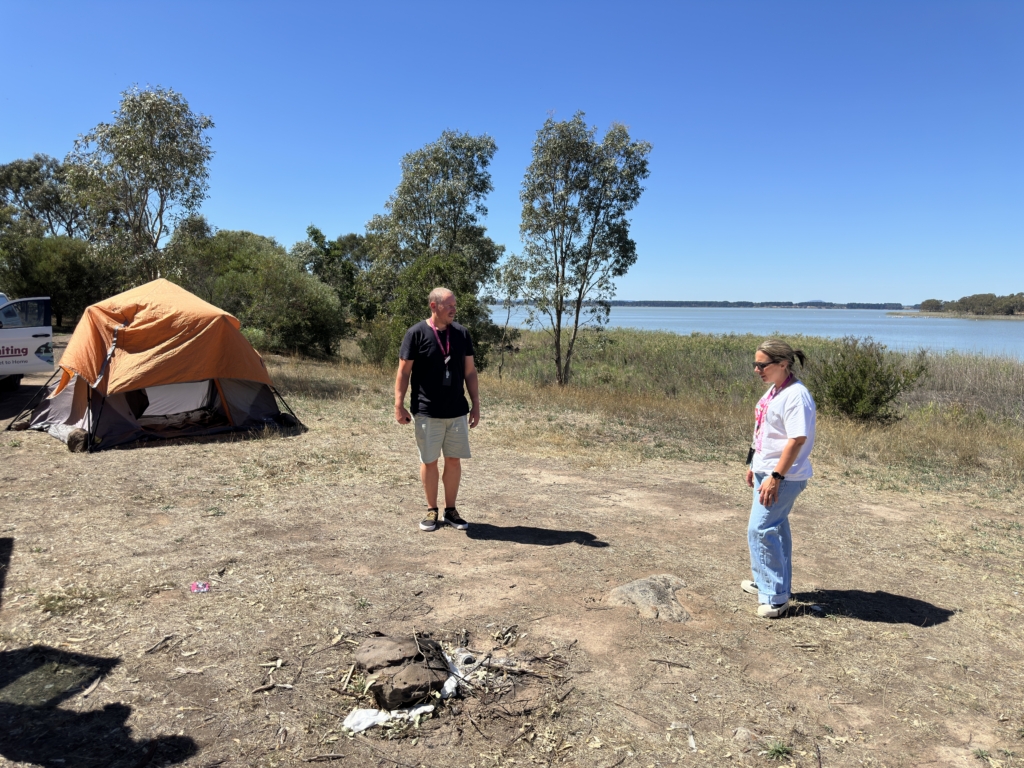
Today, the team is heading out to a spot on a lake foreshore. It currently has 20 or so regular campers though can get up to around 40.
“There’s a family out there,” says Ada. “They’ve just actually got an offer of transitional housing.”
She’s keen to get out there and see how they’re getting on. Behind the wheel of a 4WD, she pulls out of the Uniting car park, following Luke in the van ahead.
Ada’s been in the Street 2 Home team for three years and describes it as “the best job in the world”.
“One of my favourite things is just building rapport with people,” she says. “And helping them build some faith back in everything that they thought was lost. That’s pretty special.”
Workers like her find people sleeping rough and approach them with consistent, compassionate offers of assistance. They offer small items of material aid, connect people with health services, and provide support putting together applications for the Victorian Housing Register.
The primary purpose of assertive outreach is to put people who would otherwise have difficulty engaging with services on a pathway to stable and appropriate housing – though this can prove challenging when housing options are limited.
Ada says outreach workers adopt a “softly, softly” approach when building trust with people.
“Sometimes it’s really hard to get people to engage when they first meet us, when we first pop out, because they don’t know who we are.
“They don’t want to engage because they’re unsure. They’ve been let down [in the past].”
About 20 minutes outside of town, Ada pulls onto a dirt road into the campground and starts scouting to see who is here today.
She drives past a series of tents, cars and caravans tucked under the shade of gum trees.
“This first camp here – that’s Peter*. We first met him when he was in Ararat,” she says, driving past slowly. “His carer Sue* comes out to see him.”
“That guy there in that van, he’s been here for a really long time – he doesn’t want anything from us.
“That little caravan there, that’s a lady named Tina*, but she hasn’t been here for a while.
“This is Jenny*. She’s been out here for probably four years. This here is our family. And then down here is Susan*. She’s been out here for about 12 months.”
In the distance, a bright sheen comes off the lake as flocks of pelicans cruise around on its surface. It’s the day after a long weekend and several holidaymakers are packing up their gear to head home.
“We always give people a wave,” says Ada. “Though sometimes we’re not welcome.”
A group of sovereign citizens has been giving the team trouble at another site.
Today the campground seems tranquil, though that’s not always the case. In winter, Ada says, the “wind just comes off that lake like razorblades”. On days of extreme heat, it’s baking.
In January, when bushfires were about to rip through the area, the team had to race around to warn rough sleepers of what was coming, and rush to find accommodation in motels.
“With these guys – I see their desire to just want to help. They offer you that in spades.”
Ada pulls up and gets out of the car. A little white dog comes zooming over. His owner Maree* smiles and waves as she sees Ada and Luke.
Luke starts setting up the portable barbeque in a small, sparse rotunda. The campground doesn’t have much in the way of facilities – no running water, and just a few drop toilets which are often dirty.
The pair unloads packets of sausages and burgers and some bacon, cheese, eggs and onion.
“I’ll go and tell people we’re cooking,” says Ada, hopping back in the car.
At one campsite she pulls up to, a full washing line is strung up next to several large tents and cars.
“Good day for washing!” Ada calls out.
Karyn* is here with her two teenage sons – they’re the family who’ve just been offered transitional housing, after three years of camping out. They’re starting to clean up their site to prepare to move.
Karyn tells Ada about a guy hanging round the site who she didn’t recognise: “I think he was rifling through my stuff.”
She sighs. “I can’t wait to get out of here.”
Ada pops into see Ava* – “she’s our festival-goer” – and asks how her car is going, asks after her mum. She sees Dylan* and Lia*, a young couple who emerge from their tent to go and check on the fishing nets they have out in the lake.
As she walks back to the rotunda, a man approaches. Ada hasn’t chatted with him before.
“Hey, I’ve got a question for you guys,” he says. “My partner – she’s actually nearly going to be homeless. She’s two weeks behind on rent.”
Ada listens attentively before suggesting what the team could do.
“So, I’m part of the Street 2 Home program. We work with people who are rough sleeping and do what we can to help.”
She tells him about the Private Rental Assistance Program and suggests it’s worth having a chat. She invites him to the barbeque and says she’ll also come back to follow up at another time.
“Yeah, that’s all right,” says the man. “I thought because I’ve seen you guys already quite regularly, I thought I’d just come and talk to you – because she’s ashamed of trying to get help.”

At the rotunda, the cook up has started and people are beginning to wander over. Someone adds a couple of packets of chocolate biscuits to the spread; Sue brings out some rocky road and a tub of tomatoes that she’s grown at home. She got the house thanks to help from the Street 2 Home team; now she comes back to the campsite to care for Peter.
Peter has been at the site since November, though the team connected with him a couple of years ago at another campground in Ararat.
“I’m out here by choice,” he says, standing next to Sue near the barbeque.
Once a journalist, Peter had a ten-year stint of sleeping on the streets in Adelaide and experienced deeply traumatic experiences in that time. He’s since been in housing but found it distressing, so decided to return to camping out.
Peter says he can find it hard to accept help from people, though he has learned that the Street 2 Home team genuinely wants to support him.
“With these guys – I see their desire to just want to help. They offer you that in spades,” he says.
“They’re not intrusive, but they are consistent – that is key.
“It might take a week a month a year, but if you build that connection with people, that makes it work.”
The team try to get out to each of their regular sites once a week – not always for a barbeque, more regularly they’ll simply go round and check in on people, ask what they need.
Luke and Ada start packing up the spread, distributing the leftovers to anybody who wants them.
“Do you want some bread, Peter?”
Peter hesitates for a beat. “Yes, okay – thank you.”
After waving everyone goodbye, Luke and Ada discuss where to go next: “Should we drive around to the other side?”
At a much smaller site on the far side of the lake, they find a single orange tent. It’s empty, possibly just abandoned after the long weekend.
Pulling back onto the highway, the pair head closer to town to check on several sports ovals.
At one site, the council has recently modified the club building to stop people from sleeping in doorways and fenced off the grandstand to prevent people from climbing in.
Today there’s nobody there. It’s not easy for the team to keep track of where people go when they move on; Luke says, “it’s like they just spread to the wind”.
While assertive outreach can be deeply rewarding for workers, there are frustrations and things that weigh heavily.
“Unfortunately, we see a bit of domestic violence,” says Luke. “And every time you find a kid [is really hard].”
Another huge obstacle is the severe lack of homes available to direct people to.
On the way back, we drive through “the horseshoe” a site that’s fenced off with purple Big Housing Build signage. Existing public housing was knocked down to make way for the build, which promises 181 homes; it’s now sat as vacant land for three years.
The dearth of available housing in the area means the team has to look far afield to place people. Luke recently found a home for someone in Orbost – a six-hour drive from Ballarat to the other side of Victoria.
Back in the office, the team look at their whiteboard list: “Oh, we’ll have to add Susan.”
Stacey Park, Uniting’s assertive outreach manager, pops her head round the door.
“How did you go out there today?”
Stacey says another huge challenge for their team is the lack of certainty around funding. It means they can often only hire for short, fixed-term contracts.
“We lose the opportunity to maintain really skilled professionals,” she says.
Uniting’s Street 2 Home team is down to two outreach workers – they once had four; though they now also work closely with two Advance to Zero workers, who cover rough sleepers in the Ballarat CBD.
“Street 2 Home has lost all of their staff and re-recruited and lost all of their staff and re-recruited for as long as I’ve been part of the program – about seven to eight years,” says Stacey.
As consistency is essential for building relationships and trust with those they are supporting, turnover in the team is disruptive.
“There are more people that need help than what we can get to – and it feels like an increasing number.”
Stacey says she’s constantly impressed by the resilience and perseverance of the team. One particular story stands out in her mind.
“We had one client that was just so complex. Every time we walked up to him, [he’d tell us to] go away, swear at us, use really vulgar comments to scare us away,” she says.
“Over five or six years, people kept trying. Everybody in the program kept trying. And we had one social worker named Baz who wanted to give it a go.
“[Baz] went out and just kept engaging him and just was really committed to getting this guy some support.
“Now, he’s in housing. He’s still struggling, but now he will open the door and talk to anybody that approaches,” says Stacey.
“You know, the whole team here, they just don’t give up.”
Last year, three-year funding for assertive outreach was secured from the Department of Families, Fairness and Housing (DFFH) under the Rough Sleeper Action Plan in eight areas in Victoria, including Ballarat.
This medium-term commitment was welcome, though other teams that Uniting’s assertive outreach team works with closely, such as supportive housing, currently only have one year of funding, causing continued uncertainty.
Looking across Victoria, assertive outreach funding is extremely patchy. Gippsland currently has no funded assertive across the entire region. In the Wimmera, there is just a single assertive outreach worker, funded through philanthropy, who covers close to 34,000 square kilometres by himself.
In metropolitan Melbourne, there are a handful of assertive outreach programs funded through the Rough Sleeper Action Plan; some local governments are resourcing small programs, and a few homelessness organisations are fundraising to do some assertive outreach where they can.
Demand for assertive outreach far outstrips supply across the state. Luke says rough sleepers are increasingly coming up from Melbourne to Ballarat to access homelessness services.
“There are more people that need help than what we can get to – and it feels like an increasing number,” he says.
Despite the pressures, Luke and Ada both say the job continues to be deeply fulfilling.
“One of the things for me is just being able to gain trust from somebody that’s had no trust in anybody because they’ve been let down so many times,” says Ada.
She glances at the names on the whiteboard.
“It’s really special being someone’s person.”
*Name has been changed.